Fast and Bonnie

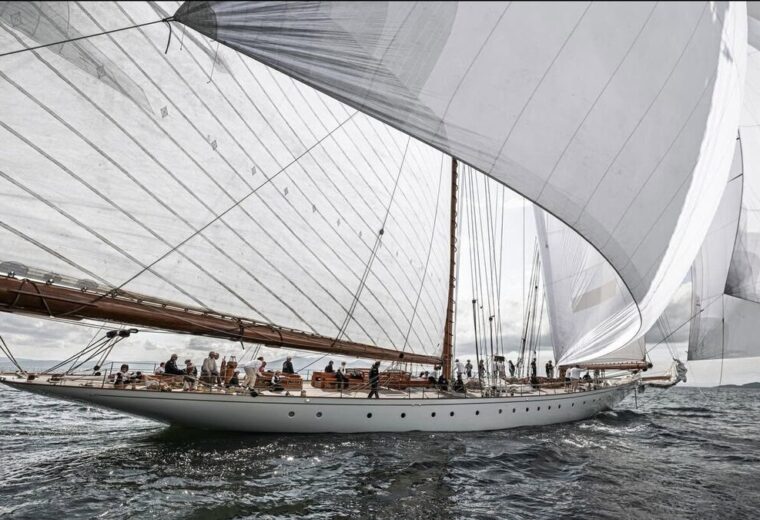
Credit: Richard Mille Fife Regatta
This feature article originally appeared in AFLOAT Magazine and forms part of our latest edition of boating features exploring classic yacht regattas and sailing heritage.
John Cowpe returns to his Scottish village, Fairlie, for the 2026 Richard Mille Fife Regatta.
There are few moments in sailing when history, craftsmanship and personal memories all converge. For me, so it was, in June when I returned to my hometown of Fairlie on Scotland’s west coast for the Richard Mille Fife Regatta. Having lived in Australia for many years, sailing has taken me to remarkable places, but standing once again on the shoreline where William Fife III built some of the world’s most beautiful yachts felt special. As the fleet sailed in parade past the old Fairlie yard before racing commenced, it was time to reflect on the extraordinary legacy that began in this quiet Ayrshire village more than 150 years ago.
The Fife yard, established by William Fife and later developed by his grandson William Fife III, became synonymous with elegant and beautifully balanced yachts; in Fife’s own words “They must be Fast and Bonnie” – and indeed they are. Between the late 19th century and the outbreak of the Second World War, the Fifes of Fairlie produced some of the most celebrated racing and cruising yachts of their time. Their graceful overhangs, sweeping sheerlines and impeccable craftsmanship have ensured that Fife yachts remain among the most sought-after classic yachts in the world.
Regatta 2026
The 2026 regatta attracted 22 classic yachts from across Europe and beyond, ranging from elegant metre boats through to magnificent large offshore racers. Every yacht carries its own remarkable history, yet together they represent one of the greatest collections of classic sailing yachts assembled anywhere in the world.

The opening day was particularly emotional for the local community. Before the first start, the entire fleet paraded along the Fairlie shoreline directly in front of the former Fife yard. Local boats joined the procession, while spectators lined the waterfront. For many in the village – including myself – it felt less like the start of a regatta and more of a homecoming. The racing itself delivered exactly what the Firth of Clyde is famous for – ever-changing conditions that tested both crews and tacticians.
Day one opened with a fresh easterly breeze and challenging gusts funnelling off the shoreline as the fleet tackled the Cumbraes course. The following day produced classic Scottish weather. Strong southerly winds of almost 30 knots delayed the start for several hours before competitors eventually launched into exhilarating downwind racing under dark skies and heavy showers. William Fife would surely have approved of seeing his century-old designs still charging through these demanding conditions.

Loch Fyne
By contrast, racing to Loch Fyne presented crews with almost every weather condition imaginable. Calm passages through the Kyles of Bute gave way to drifting starts, sunshine, rain showers and finally light northerlies that rewarded patience and constant sail changes. It was a reminder that success on the Clyde has always depended as much on reading the weather as on boat speed.

The regatta concluded appropriately with the historic King’s Course, where strengthening westerly squalls provided a spectacular finale. Race officials shortened the course for the smaller yachts while the larger classics stretched their legs in open water north of Great Cumbrae, providing a fitting conclusion to five days of outstanding racing.
Overall honours reflected both consistency and exceptional seamanship across the week. While every yacht represented a masterpiece of naval architecture, the results demonstrated that these vessels are far more than museum pieces – they continue to race hard, rewarding skilled crews who understand both traditional seamanship and modern race tactics.
Watching these magnificent yachts return to the place where they were conceived and built reinforced just how enduring William Fife’s legacy remains. Fairlie may be a small Scottish village, but its influence on yacht design reaches every corner of the sailing world – including Australia, where many sailors have admired or raced aboard Fife-designed yachts.

Standing on the shore where those elegant lines first took shape, it is clear the Fife Regatta is far more than a classic yacht event. It is a celebration of craftsmanship, maritime heritage and the enduring appeal of beautiful boats built to sail – not simply to be admired.
Some places never really leave you. Returning home to Fairlie and watching the world’s finest Fife yachts sail once again from the waters that shaped them was a reminder of exactly that.
Full class results are available through the official Fife Regatta website: fiferegatta.com.
William Fife III
The third William Fife is probably the most famous of the three Fife dynasty. He is particularly remembered for his designs for Sir Thomas Lipton’s America’s Cup challengers Shamrock I and Shamrock III and the 23-Metre Shamrock, his designs for the metre classes especially the 6-Metres, various one-design classes, many beautiful cruising yachts and ocean racers. He died in 1944 and his nephew Robert Balderston sold the business after the Second World War.

Entrants 2026

This feature article originally appeared in AFLOAT Magazine. To explore more stories like this, browse the AFLOAT Magazine archive or view the latest edition of AFLOAT Magazine.