
Sailing’s Greatest Mistake – the Etchells Story

Credit: Australian Etchells Association
This feature article originally appeared in AFLOAT Magazine and forms part of our latest edition of boating features exploring Olympic sailing history and the Etchells’ enduring legacy as a one-design class.
David Salter recalls the travesty of justice that still blights Olympic yachting.
Sixty years ago, the authorities who ran sailing had the opportunity to set a new benchmark for the sport on an international basis. They blew it. The history of that blunder is a reminder of how damaging pettiness, politics and misplaced nationalism can be, and still are.
By the mid-1960s there was widespread disenchantment with the Olympic keelboat classes. Modern design trends and construction methods were making the Dragon obsolete. The 5.5 metre, a development class under the old International Rule, always raised questions about fair racing between expensive yachts that were not truly identical. In 1965 Yachting magazine attempted to meet those concerns by establishing a design competition to find a new three-man Olympic keelboat. The assumption was that there should be a regatta pitting the hopeful prototypes against each other. Whichever boat won would then be recommended for adoption by the International Yacht Racing Union as the new Olympic class. It was a perfectly sensible proposal.
Etchells
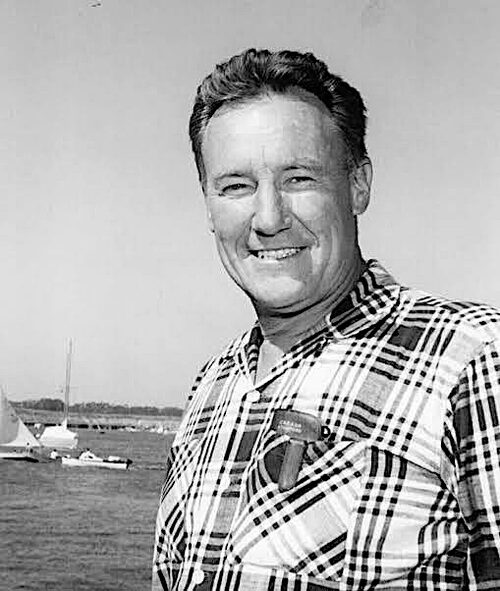
In the US, Elwood W. ‘Skip’ Etchells, a seasoned boat designer, builder and sailor, accepted the challenge. Etchells was no self-taught enthusiast. He held a degree in engineering and naval architecture from the University of Michigan and had worked in the design office of Sparkman & Stephens before establishing his own boatbuilding business in Connecticut. The Star class yachts produced by his Old Greenwich Boat Co. were much sought after for their speed. Etchells himself raced in the Stars with his wife Mary as crew. They won multiple international regattas, including the World Championship in 1951.
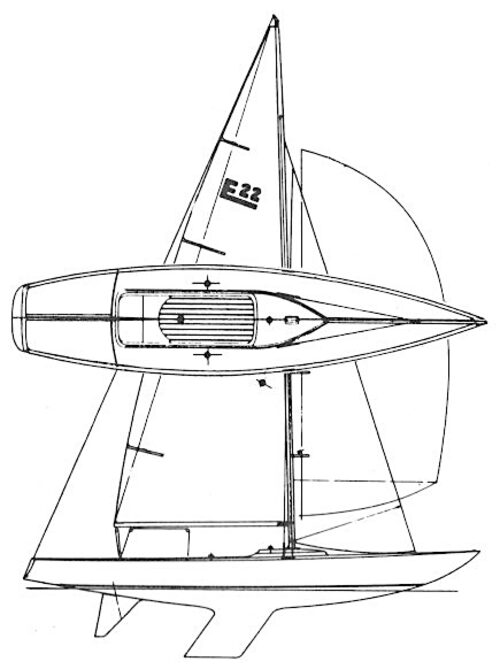
The maximum limits proposed for the new Olympic class were simple enough: 22 feet waterline, 4’6″ draft, 3,700 pounds displacement, 310 square feet of working sail area and a crew of three. Etchells’s response was an elegant fractional sloop he named Shillalah, 30 feet LOA and built in timber. Eight boats contested the 1966 trials at Kiel, Germany. That fleet boasted some impressive pedigrees. There were two designs by Van der Stadt, and one by Britton Chance Jr. Also entered was a Soling – recently established as a class in Europe – and marginally smaller than the rule.
Skip’s design won a convincing 8 of the 11 races. Its stability over a wide wind range and low wetted surface hull underpinned that dominant result. Etchells later explained the three losses. One was a navigational blunder, another he’d been forced ashore to fix rigging damage, and the third when they “set the chute like a sea anchor”. But there was no doubt Shillalah had established itself as the superior design.
In a just world, that would have been the end of the matter. But members of the Observation Committee who were charged with making a choice found obscure reasons not to be convinced and postponed any final decision. They wondered whether the Soling might have the potential to emerge as the winner if given another chance. So, a second trial was organised for 1967 in Travemünde.
Etchells was reluctant to take part, reckoning that “the fix was in”. But the only American on the Committee – Bob Bavier, an America’s Cup veteran – wrote Skip an encouraging letter. In it he suggested “if you had a fibreglass boat in the next set of trials and she did just reasonably well she would almost certainly be chosen.” So, Etchells used Shillalah as the plug to build a fibreglass version of his boat – Shillalah II. Again, it trounced the opposition, winning 10 of the 13 races against a nine-boat fleet that included two Solings.
International Yacht Racing Union
Game, set and match? Not quite. The politics of international sport proved more powerful than mere sailing superiority. The Committee dithered and eventually issued perhaps the most self-incriminating judgement in yachting history: “The Observation Committee is of the opinion that the Soling fulfills the requirements of the Union for a new three-man keelboat and therefore recommends it to be encouraged by the International Yacht Racing Union.” Their report on the trials did not even mention Shillalah.
As expected, the IYRU then confirmed that they would nominate the Soling to replace the Dragon at the Olympics. Dejected, Etchells took his boat home. When he pressed the Committee for an explanation as to why his design had been ignored he received a terse document in reply. The reasons given were that the boat was too expensive, too heavy, the cockpit was too big, there were no seats for the crew, and that it was “a very ugly boat”!

One-design racing
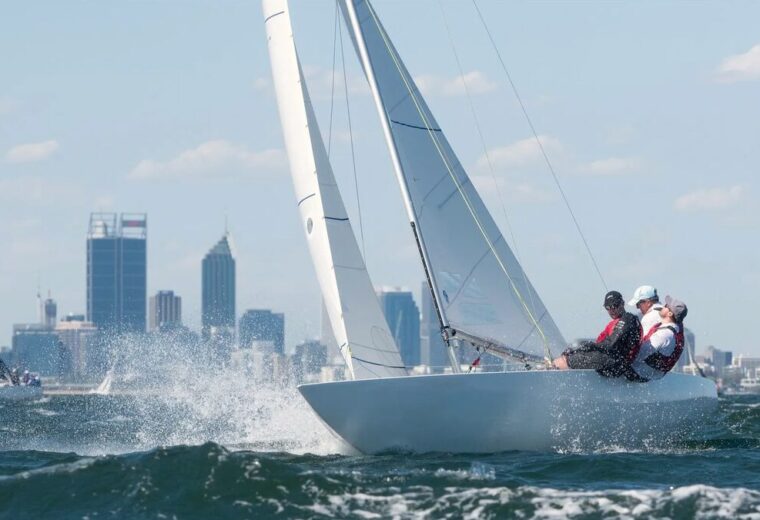
Notwithstanding these supposed drawbacks, local sailors in the US appreciated the design and within six months there was a healthy fleet of E22s racing on Long Island Sound. It is difficult to believe now, but it took until 1974 for the IYRU to even recognise the Etchells as an international class. By that time, it was booming. More than 1,200 have now been built. Around 750 of those race regularly in at least 50 established fleets around the world. Not bad for a boat designed six decades ago. The Etchells is patently still the most practical and appropriate keelboat for the Olympics. The one-design is timeless, strictly controlled and trailerable. It is a simple, fast sloop raced in conventional ways the public can follow. Retaining the original white Dacron as mandated sail material for the class helps keep costs reasonable and the boats looking like proper yachts.

The foolishness of the IYRU (now World Sailing) and the IOC in rejecting the Etchells is confirmed by the continued popularity of the class at the elite level. The world championships are a true pinnacle of the sport where many of the greatest sailors have participated, and still do. Iain Murray, John Bertrand, Ken Read, Dennis Conner and Colin Beashel have all won – many of them multiple times. They savoured the opportunity to test themselves against the best in a pure sailing competition. Meanwhile, the Soling was dumped from the Olympics after the 2000 Games. In Australia the few that survive are now mostly used as mooring minders. The Olympics still haven’t established an acceptable keelboat class. The same type of bickering that doomed the Etchells scuttled recent proposals to introduce a two-handed offshore event at the Games.


Iain Murray, John Bertrand and Dennis Conner have all won World Championships in the class.

Towards the end of his life (he died in 1998, aged 87), Etchells reckoned he’d finally learnt the lesson from his boat’s rejection. He told his son: “In working on a new one-design, forget experience and the drawing board. Concentrate on political science.” What a glorious opportunity for the sport was squandered back in 1966.

This feature article originally appeared in AFLOAT Magazine. To explore more stories like this, browse the AFLOAT Magazine archive or view the latest edition of AFLOAT Magazine.