
@dventures of Captain Liz – Becoming A Yacht Captain


Captain Liz aboard a racing catamaran in Thailand. Photo: Cape Panwa Race Week/Guy Nowell
This feature article originally appeared in AFLOAT Magazine and forms part of our latest edition of boating features exploring life at sea and the realities of professional yacht captaincy.
I’ll never forget my first time officially being the captain of a voyage, recalls Captain Liz.
Although I had already sailed thousands of miles and had the wisdom from many adventurous and challenging experiences up my sleeve, having the training wheels come off was still a bit nerve-wracking. It made me realise the faith and confidence I placed in the person wearing the captain’s hat, and the sense of security that came from that trust. The weight of responsibility suddenly felt much heavier than I had imagined. It was now me who was supposed to be emanating confidence and giving the rest of the crew comfort. If something went wrong, it was now me who had to make the decisions. Me!
Over the years I have sailed with captains I wanted to be like and captains I never wanted to become. Between the two, I have learned a lot about what makes a good captain and I am still learning. This first experience brought many of those lessons together, and I hope it helps you either become a better captain or choose to sail with one.
Early days
My first command was a yacht delivery of a Ker 42 racing yacht from Singapore to Hong Kong during the NE season (upwind), approximately 2,000 nautical miles. We headed down the Malacca Strait, then east, hugging the coast of Borneo to Palawan in order to stay out of the worst of the upwind conditions and gain enough windward ground before turning for a more favourable wind angle across the South China Sea to Hong Kong. The boat was a super nice, fast, technical carbon-fibre racing yacht. So much fun for racing around the cans, but for living aboard on a multi-day passage, well, let’s just say that’s the type of situation I thought was fun in my youth but would no longer sign up for. Let me paint you a picture.
Imagine an empty carbon-fibre hull. That’s the picture. There is zero interior besides a few bunk-bed cots and the engine. The toilet was hanging off the rails overboard. The galley consisted of holding a pot over a camping stove while squatting on the floor. A shower was a few wet wipes and maybe a ration of precious fresh water from a bottle or making use of some rain. The cockpit had no cover, so no matter the wind, rain, or midday sun, you were just in it. Stuck on the tiller-steered helm that you couldn’t let go of for a second because there was no autopilot. Tiller steering also means you spend hours and days on end looking to one side, which can get a bit uncomfortable after a while. And let’s not forget butt rash, shall we?
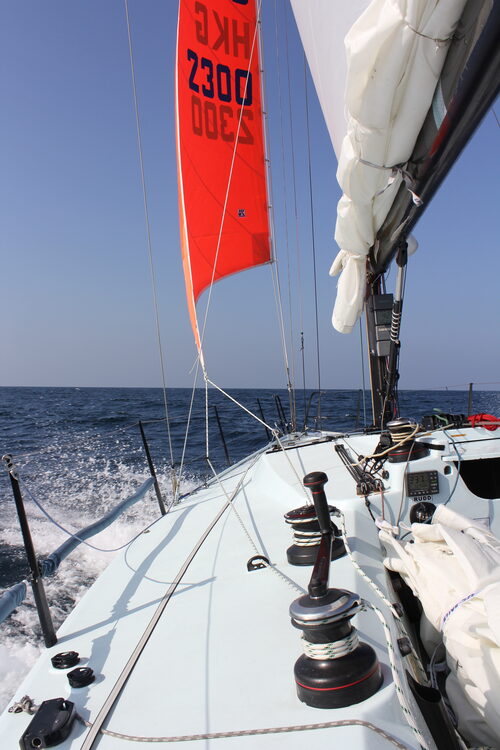
On top of all that, the fancy sliding front hatch that lets you pull a kite down smoothly, leaked like a bitch, especially going upwind with waves over the bow, allowing around 100 litres per hour to pour straight into the boat. The bilge pump should have been mounted on the wall rather than in the floor because sailing with a 15-degree heel angle meant the boat had to take on a serious amount of water along its entire length before it would even reach the pump. Every hour we had to luff up and flatten the boat for a few minutes to let the pump work.

Crew
A full suite of racing sails, plus fuel storage inside, meant life was generally a cramped, salty, oily soup. But we weren’t complaining. That’s the life we loved and were happy to do.
I’m grateful that, even though it was my first time as captain, I made the most important choice a captain can make: I got myself a good crew. Crew who accept these kinds of conditions while maintaining a smile. Crew whose abilities you trust enough to hand over the tiller and actually get some sleep. Crew who can help make tough decisions and remind you if you’ve forgotten something. And especially at that point in my sailing career, a crew who actually had more experience and technical knowledge than me was exactly what I needed and exactly what I made sure I had.

RYA Yachtmaster Instructor
Later in life I became an RYA Yachtmaster Instructor, and I always made sure to teach this lesson to my students. As a newly licensed and inexperienced skipper, take a supportive crew rather than people who are not sailors, know nothing, and can’t help you. That’s part of your responsibility as skipper – to make preventative decisions like that. Gradually expanding your comfort zone is key to maximum enjoyment and safety for everyone. More than once I have seen the classic husband-and-wife team pursuing their dream of sailing the world in retirement. They later arrive in port with bags packed and a boat listed for immediate sale – or immediate divorce – because they didn’t respect the importance of bringing appropriate crew for the trip.

My crew was Aneta, a bestie and a woman with whom I had sailed many delivery and racecourse miles. She always has a big smile, is incredibly strong, and seems to genuinely crave the challenge and hardships of a good sailing adventure. The other crew member was Hamish, a man with more muscle, engineering knowledge, and offshore experience than even us salty tough girls. He was calm, collected, and completely unthreatened by girl power. As much as I am strong and can fix engines, in my experience some things seem to come more naturally to most men, and I am perfectly happy to stand back and manage through observation and suggestion, letting someone else get their hands dirty. I’ll also happily allow him to carry heavy, stinky fuel jerries.
Independent
Can I do it all myself? Sure. But I can also allow others to use their strengths. This is another notable point about being a good captain. Like asking the tall person to reach something from the top shelf. In fact, a captain doesn’t even have to lift a finger if they have prepared properly and put the right people in place to do what needs to be done. That’s when you know you’ve made it – when you don’t actually do anything except tell other people what to do. It’s often a sign of an immature captain when they don’t delegate and can’t clearly communicate what needs to be done and how to do it because they’re still used to being the one doing the task rather than the one managing it.
Managing takes brain power, and in tough conditions a captain must preserve mental capacity. Exhaustion and stress cloud the judgement, and that’s exactly when a captain needs to think clearly and hold it together. My decision-making abilities were tested on this first trip when, in the middle of a reasonably windy night, Hamish and I were on deck changing shifts when a loud bang struck a flash of panic into my already weary demeanour. The forestay tang had snapped clean off.
Barely able to make sense of what had happened in the dark while on the helm, Hamish was quick to assess the situation and gave the command: “Bear away! We’ve lost the forestay!”
Turning downwind to relieve pressure on the rig gave us some time to think. We got Aneta out of bed – still in her underwear and half asleep, not knowing what was going on – and put her on the helm with a bearing to steer while we went forward to investigate. There was no way to fix it immediately, so at that point the sail was effectively acting as the forestay. The only problem was that we had already been discussing a sail change due to the conditions. While sailing downwind, we clipped the spinnaker halyards and spare jib halyard forward, changed to the smaller jib, and then came back up onto course. I’m not sure it would have gone so smoothly without Hamish there.
While I had experienced plenty of problem-solving situations at sea, this was my first time dealing with exactly this one. When someone knows what to do, the process becomes smooth and straightforward, and I was grateful for the teamwork we had.

Learnings
Besides the struggle of living in conditions that, at the time, we all took for granted (except perhaps the amount of water inside the boat? and the butt rash if I’m really honest) it was a straightforward trip and a success for me at that point in my captaincy.
So, some points for becoming a good captain that I learned on this trip, as well as over many years and many situations:
- Bring a crew who can support your weaknesses and enhance your strengths.
- You are the decision-maker, not the do-everything-er.
- Manage your energy – you never know when your sharp judgement and quick wits will be required.
- Allow others to shine and be grateful for collaboration.
- Always choose safety and stay within your comfort zone.
- If you’re thinking about reefing, reef. Don’t delay. (I’m adding this point because I think every captain has been caught out by that cloud that came in much quicker and heavier than expected).
- Stay calm. Never let them know you’re freaking out. There is always something that can be done to improve the situation. (My other articles in Afloat magazine demonstrate this point).
- If you’re an angry, easily stressed person who can’t communicate orders but still think you’re a good captain – no one wants to sail with you. Sail solo and you’ll finally discover that you’re the problem. (This is the captain you don’t want to become, nor sail with – I reckon there’s an audience out there who can relate).
- These days, my self-respect and experience also include doing due diligence on the boat, route, and owner so that I say ‘yes’ to nice boats going the right direction, in the right season, for the right wage (and no butt rash).
- Sailing is about enjoying the journey. Never forget that.
In the end, I think sailing lures people who want to be humbled by nature and the elements. To feel small and insignificant. To experience the wild freedom of the sea. To be challenged, but not to conquer nature – to conquer oneself. Being a captain is the ultimate test of this, and it is not for the faint-hearted. Good luck!
This feature article originally appeared in AFLOAT Magazine. To explore more stories like this, browse the AFLOAT Magazine archive or view the latest edition of AFLOAT Magazine.